 Plumber
 Bullhead City, AZ
Hydro Jetting in Bullhead City, AZ
High-pressure water scouring that strips grease, scale and slurry from pipe walls — the reset button for drains that keep clogging.
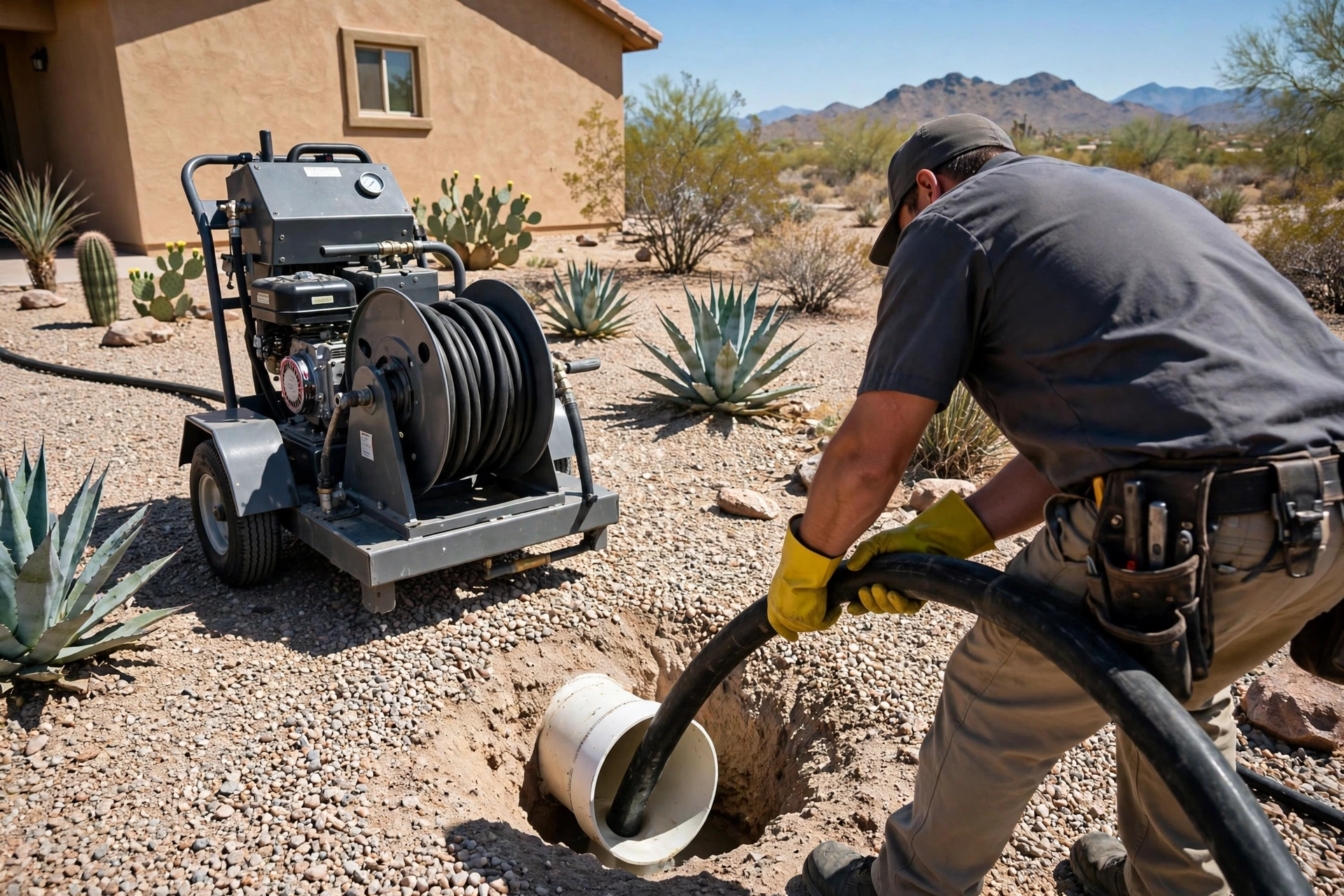
Hydro jetting is drain cleaning taken to its logical end: instead of poking a hole through a blockage, a jetting nozzle pulled through the line fires backward-facing jets of high-pressure water that scour the pipe wall itself, stripping grease films, mineral scale, soap curd and fine root hairs, and flushing everything downstream. For Bullhead City homes whose drains clog again and again, jetting is usually the difference between another temporary fix and a line that behaves like new.
This page explains when jetting is the right tool, when it is not, how the job runs, and how it pairs with a camera inspection so you can see the before and after for yourself.
For pricing context before anything else, the Bullhead City cost page publishes the market ranges hydro jetting sits inside — starting with drain clearing, auger (market range): About $63–$315 — the comparison point for a simple clog. And if your symptom is broader than hydro jetting, the Bullhead City plumbers homepage routes every common symptom to the right service.
What hydro jetting covers in Bullhead City
A jetter is a pump, a hose and a set of nozzles sized to the pipe. Working from a clean-out, the operator feeds the nozzle into the line; the rear-facing jets both cut the build-up and pull the hose forward, while the flow carries loosened debris to the sewer or septic outlet. Pressures and nozzles are matched to pipe material and condition — a sound PVC or cast-iron line can be scoured aggressively, while a fragile, cracked line needs a gentler approach or repair first.
Jetting earns its place in Bullhead City for three recurring situations: kitchen lines furred with grease over scale, main sewers with early root intrusion along the river-adjacent streets, and manufactured-home or slab lines where years of build-up have quietly halved the pipe's effective diameter. It is also the standard preparation before a camera inspection gives a truthful picture, and before any lining or repair work.
Warning signs you need this service
- The same drain or main clogging again within months of an auger clear
- A kitchen line that runs slow despite no single blockage being found
- Grease or black slurry coming back up during clearing
- Roots confirmed on camera but the pipe itself still sound
- A sewer smell that persists after traps and vents are checked
- A home purchase where the drains' real condition is unknown
- Restaurant, rental or guest-heavy use pushing a marginal line over the edge
- Standing water in the line on camera — a belly holding grease and solids
What causes it here
Jetting treats the build-up itself, and in Bullhead City that build-up has a recipe: hard groundwater scale roughens the wall, cooking grease plates onto the roughness, soap and detergent bind it, and desert dust and grit washed from patios add weight. In mains, root hairs thicken the mat from the outside in. An auger restarts the cycle by opening a channel through the middle; jetting removes the wall layer the cycle grows from.
How the work is done
Good jetting work is sequenced. First the line is checked — ideally by camera — because blasting a shattered pipe helps no one. The operator then works from the downstream clean-out upstream, making repeated passes until the return water runs clear and the nozzle travels freely. Grease jobs may use a rotating nozzle; root jobs a cutting head, followed by jetting to wash the cuttings out. A final camera pass on problem lines verifies the result instead of asking you to take it on faith.
In depth — what experience teaches about this job here
Jetting rewards technique more than force. The operator works the nozzle in passes — breaking the head of the build-up first, then letting the rear jets scour on the pull-back, which is where the cleaning actually happens. Rushing a single fast pass polishes a channel; slow repeated passes strip the wall. On grease work the return water tells the story, running black and heavy before it clears. On root work, the cutting head goes first and the jetter follows to wash the cut mass out, because roots left lying in the line become the next mat's skeleton.
There is also a diagnostic dividend. A jetted line can be camera-inspected truthfully — the camera sees pipe, not sludge — so jetting day is often the day a household learns its sewer's real condition for the first time: the joint offsets, the belly nobody suspected, the section that will need repair in two years rather than tonight. That knowledge, priced into one visit, is worth more than the cleaning itself for owners of older Bullhead City stock planning their next few years of maintenance.
How your housing type changes the job
Slab-built homes. Under-slab lines are jetting's best local case: the wall build-up can be scoured without opening a single tile, and the camera pass afterwards certifies the concrete can stay closed.
Manufactured homes. Belly-routed drains are jetted at pressures matched to their size and material, with access chosen so the enclosure is disturbed once and refitted properly.
Seasonal homes. A home returning after months away benefits from jetting before the guest load arrives — the line starts the season at full bore instead of at last season's narrowing.
- Keep grease out of the line in the first place — wipe pans into the trash, not the sink
- Run hot water after washing-machine cycles to move soap residue through older lines
- Fit simple strainers at showers and kitchen sinks and clean them weekly
- If a clog returns twice in a season, book jetting plus camera rather than a third auger visit
- Ask for the camera footage on main-line work — seeing your own pipe settles every argument
The visit, step by step
Call with the clog's history — how often, which fixtures, what was tried
Line condition is checked so pressure and nozzle match the pipe
Jetting passes scour the wall until return flow runs clear
A verification flow test (and camera pass on mains) confirms the result
You get a realistic maintenance interval based on what was in your pipe
What it costs — market ranges
| Item | Range / basis |
|---|---|
| Drain clearing, auger (market range) | About $63–$315 — the comparison point for a simple clog |
| Hydro jetting service | Quoted by line length, diameter and build-up; above auger pricing, below repeat-visit cost |
| Camera verification | Recommended on mains and recurring clogs; priced by scope |
| Root cutting + jetting | Quoted after camera confirms roots and pipe condition |
Ranges above draw on the published Bullhead City market data collected on our cost page. Your figure is set after the job is seen, and explained against those ranges.
Jetting is a planned service, not the first move in a sewage backup — an actively backing-up main is cleared and made safe first, then jetted once flow is restored and the pipe's condition is known.
Hydro Jetting FAQs
Is hydro jetting safe for older pipes in Bullhead City homes?
On a sound pipe, yes — pressure and nozzle choice are matched to the material. On a cracked, crushed or heavily corroded line, jetting can worsen the damage, which is why a camera check comes first on older Riviera, Holiday Highlands and manufactured-home lines. If the pipe is too far gone, you will be told repair is the honest spend.
How is jetting different from snaking my drain?
A snake (auger) punches or screws through the blockage and opens a channel roughly the width of its head. Jetting strips the build-up off the entire wall and flushes it out, restoring the pipe's full diameter. For a one-off hair clog the snake wins on price; for grease, scale and recurring clogs, jetting lasts far longer.
How long does hydro jetting last?
It depends on what the household sends down the line afterwards. A grease-heavy kitchen line in a hard-water home might need attention every couple of years; a scoured main with roots treated can run clean much longer. The operator can give you a realistic interval after seeing what came out of your specific pipe.
Can jetting remove tree roots from my sewer line?
Jetting with a cutting nozzle removes root masses and washes them out, and for early intrusion in a sound pipe it is an effective reset. Roots return through the same joints over time, though — if the camera shows heavy intrusion or joint damage, sewer line repair or replacement is the durable fix, with jetting as maintenance between.
Does jetting work for manufactured homes?
Yes, with care: manufactured-home drain lines are often smaller and routed through the belly space, so pressures are set lower and access points chosen accordingly. Buena Vista, Fox Creek and Holiday Highlands homes with chronic slow drains are frequent jetting candidates precisely because their lines fur up faster.
What does hydro jetting cost in Bullhead City?
There is no honest flat figure without seeing the line: length, diameter, access and the type of build-up all move the price. As a frame, simple auger clearing sits in the published $63–$315 market range, and jetting prices above that while typically replacing several repeat auger visits. You will get the figure before work starts, after the line is assessed.
Jetting in context: where it sits between the cable and the dig
Homeowners sometimes meet hydro jetting as an upsell, so it is worth placing the service honestly on the ladder of options. A cable machine pokes a path through a blockage and is the right, economical answer for a single soft clog in a sound line. Jetting does a different job: it scours the full circumference of the pipe, stripping the grease film, scale flakes and settled slurry that made the clog form, which is why its results last longer on lines with a history. Excavation sits above both, reserved for pipe that is collapsed, badly bellied or separated. A trustworthy recommendation can land on any rung — including the cheapest one — and the evidence that decides it is what the line looks like inside, not which machine happens to be on the truck that day.
Reading a line before choosing pressure
Jetting is controlled water pressure, and control begins with diagnosis. Pipe material matters: sound PVC and cast iron tolerate a thorough scouring, while thin-walled, corroded or cracked pipe may need reduced pressure, a different nozzle, or repair before any jetting at all. Diameter and length set the equipment, and the cleanout's position decides whether the jet works with the flow or against it. In Bullhead City's older neighbourhoods, where a single home can contain two generations of pipe, a camera pass first is not caution theatre — it is how the operator learns which sections can be scoured hard and which must be treated gently, before the water is ever turned on.
The restaurant and rental dimension
Grease-driven jetting is routine maintenance in commercial kitchens along the Hancock Road corridor, and the logic transfers to busy vacation rentals and multi-generational households in Bullhead City: high cooking volume loads a line faster than any household average suggests. For those properties, the sensible conversation is about interval — jetting on a schedule set by how quickly the line re-fouls, learned from the first camera inspection — rather than waiting for the backup that closes a kitchen or ruins a guest weekend. A scheduled scouring, done when the line is still flowing, is quicker, cleaner and cheaper in total than emergency clearing plus jetting performed under pressure of a full house.
- Ask what the camera showed, in plain words, before agreeing to any jetting recommendation.
- Keep your cleanout accessible; buried or paved-over access adds time to every drain service you will ever book.
- After jetting, ask how much build-up was found and where — that answer sets your realistic maintenance interval.
- Never jet a line blind when it is fully blocked with sewage; flow is restored first, then the scouring happens safely.
- Save the inspection footage date with your home records; comparing visits years apart shows whether a line is stable or deteriorating.
Pricing follows the line itself — length, diameter and the severity of what coats it — which is why jetting is quoted after the pipe is seen rather than flat-rated over the phone. The Bullhead City cost page places it honestly against augering at roughly $63–$315, and (928) 693-1910 is where that comparison becomes a figure for your property.
What jetting leaves behind: a line you can plan around
A freshly jetted line is also a measurable line. Once the walls are scoured clean, a follow-up camera pass shows the pipe's true condition without the camouflage of build-up: cracks, offsets, bellies and root entry points all stand revealed, and the maintenance interval stops being a guess. Grease-heavy kitchens learn how many months pass before the film rebuilds; older lines with root intrusion learn whether cutting plus jetting holds the line for years or merely postpones a repair conversation. That knowledge is the real product of a thorough jetting visit — hot water under pressure is simply how it is delivered. It converts your drain system from a recurring surprise into a piece of infrastructure with a known condition and a known schedule, which, in a city where so many homes sit empty between seasons of heavy use, is worth as much as the cleaning itself.
Jetting day, practically speaking
On the day itself, expect the work to centre on your cleanout: hoses and the jetter stay outside or at the access point, the operator works section by section toward the street or septic connection, and progress is audible as the nozzle meets and clears each band of build-up. Clearing pets from the work area, moving vehicles off the cleanout's access path and telling the operator about any recent chemical drain treatments all help the visit run cleanly. Before the equipment is packed away, the condition summary — what came out, what the camera showed, what interval is recommended — is the moment to ask every remaining question, while the evidence is still on the screen.
Related services and areas
Homeowners dealing with this often also need emergency plumber · drain cleaning · leak detection · slab leak repair · water heater repair — and local help from a plumber in Bullhead City who knows the housing on your street. Neighbourhood pages: Riviera · Riverview Park · Laughlin Ranch · Fox Creek · Sunridge Estates · Buena Vista · Holiday Shores · Holiday Highlands · Desert Foothills Estates · Arroyo Vista · Bullhead City Center · Playa del Rio · Rio Lomas · Hancock Road Corridor. Town pages cover Fort Mohave, Mohave Valley and Laughlin, NV.
Talk to a Bullhead City plumber today
One call, a real conversation about your job, and an honest next step.
(928) 693-1910Call (928) 693-1910