 Plumber
 Bullhead City, AZ
Water Heater Repair in Bullhead City, AZ
No hot water, lukewarm showers, rumbling tanks and leaking pans — diagnosed honestly, repaired when repair makes sense.
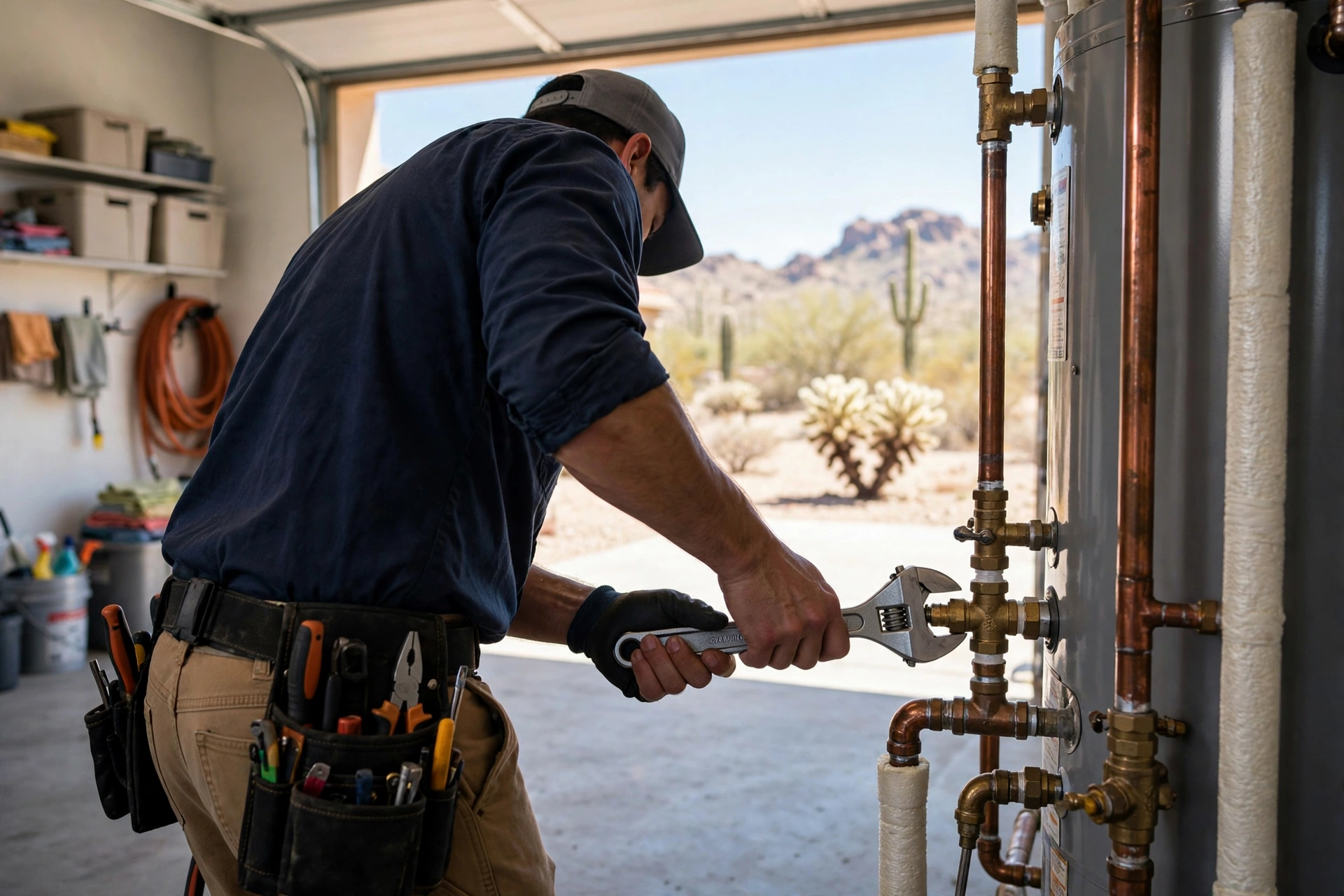
Water heater repair in Bullhead City works against two accelerants: some of the hardest working conditions in Arizona — groundwater heavy with minerals — and summer heat that keeps inlet water warm and tanks cycling in hot garages. Sediment builds faster here, anodes are consumed sooner, and a heater that might last twelve years in a soft-water city can be rumbling and inefficient at eight.
This page explains the faults that bring us out — no hot water, not enough hot water, noises, leaks, pilot and element failures — which of them repair well, and the honest point at which replacement is the better spend. If your heater is leaking from the tank itself, skip to the safety steps and call.
For pricing context before anything else, the Bullhead City cost page publishes the market ranges water heater repair sits inside — starting with typical plumbing job in this market: About $125–$450 (aggregator average range). And if your symptom is broader than water heater repair, the Bullhead City plumbers homepage routes every common symptom to the right service.
What water heater repair covers in Bullhead City
Most heater faults live in a short list of replaceable parts: thermostats and heating elements on electric units, thermocouples, pilot assemblies and gas valves on gas units, temperature-and-pressure relief valves, dip tubes, and anode rods. Repair means testing to find which part has failed rather than swapping parts until the symptom stops — a no-hot-water call can be a failed element or a dead tank, and the difference matters.
Sediment is the local multiplier. Groundwater minerals settle in the tank bottom, insulating the water from the burner or elements; the heater runs longer, overheats the sediment layer, and produces the kettle-rumbling Bullhead City homeowners know well. Heavy sediment also buries the lower element on electric units and accelerates tank corrosion — which is why a repair visit here should include a sediment and anode assessment, not just the failed part.
Warning signs you need this service
- No hot water at all, or showers turning cold far sooner than they used to
- Rumbling, popping or kettling noises as the heater fires
- Rusty or discoloured hot water, especially first thing in the morning
- Water in the drain pan, or dampness around the tank base
- A pilot that will not stay lit, or an electric unit tripping its breaker
- Fluctuating temperatures — scalding, then lukewarm, in one shower
- Visible corrosion on fittings, the T&P valve or the tank jacket
- A heater working audibly longer than it used to for the same demand
What causes it here
Element and thermostat failure lead electric repairs; thermocouple and gas-control faults lead gas repairs. Underneath many of them sits the local cause: sediment from hard groundwater forcing longer, hotter cycles that wear every component faster, and an anode rod — the sacrificial part that protects the tank — dissolving early in mineral water and leaving the tank itself to corrode. Garage installations in Bullhead City also bake in extreme summer heat, ageing controls and plastic components ahead of schedule.
How the work is done
A repair visit tests in sequence: power or gas supply, controls, elements or burner, then the tank's condition — sediment depth, anode state, corrosion at fittings. Parts are replaced with the correct rating for the unit, the tank is flushed if sediment allows, and the T&P valve is function-checked because it is the safety device, not an accessory. If the tank is perforated or the repair bill approaches the value of the remaining tank life, you will be told replacement is the better spend — see the installation page for how that decision is priced.
In depth — what experience teaches about this job here
A repair visit should end with more than a working heater — it should end with a prognosis. The tank's age, sediment depth, anode state and fitting corrosion together predict the unit's remaining life within a useful margin, and in Bullhead City's water that prognosis is the difference between planning a replacement on your schedule and funding one on the leak's schedule. Ask for it explicitly. A technician who has just tested your elements and seen your tank floor can give you that read in a sentence, and it costs nothing beyond the asking.
There is a local pattern worth naming: heaters here rarely die dramatically first — they decline audibly. The rumble deepens across a season or two, recovery time stretches, and the first lukewarm shower arrives months before the failure. Owners who treat the deepening rumble as the scheduling signal get their repair or replacement done in a calm week at a calm price. Owners who wait for silence — the day the tank gives nothing at all — buy the replacement under time pressure, with the old unit's water already looking for the floor.
How your housing type changes the job
Slab-built homes. Slab homes often closet their heaters inside the living space, which raises the stakes on pans and T&P valves — a leak there is a flooring event, not a garage puddle.
Manufactured homes. Manufactured-home heaters are frequently smaller, space-constrained units with their own fittings; parts identification on the call prevents a wasted first visit.
Seasonal homes. A heater that sat full of hard water all summer starts the season with fresh sediment settled on its floor — the return flush is a repair-preventer, not a ritual.
- Check the breaker or the pilot before calling — a tripped breaker or blown-out pilot is a five-minute answer
- Look in the drain pan: water there means call promptly even if hot water still works
- Note the unit's age from its rating plate — repairs past roughly ten years in this water need a harder look
- Never plug or cap a dripping T&P valve — it is venting pressure or temperature for a reason
- Turn off power or gas and the cold supply if the tank is actively leaking, then call
The visit, step by step
Call with the symptom, the fuel type and the unit's age if you can read the plate
Supply, controls and elements or burner are tested to isolate the failed part
Sediment and anode condition are assessed alongside — the local context of the fault
Repair is completed with correct-rated parts and the T&P valve is checked
You get a straight read on remaining tank life so the next decision is planned, not forced
What it costs — market ranges
| Item | Range / basis |
|---|---|
| Typical plumbing job in this market | About $125–$450 (aggregator average range) |
| Heater repair parts and labour | Quoted after testing isolates the failed part |
| Water-heater replacement, installed (market range) | About $762–$1,905 — the comparison when repair no longer pays |
| Annual flush and anode check | The cheapest life-extender in hard water; priced as maintenance |
Ranges above draw on the published Bullhead City market data collected on our cost page. Your figure is set after the job is seen, and explained against those ranges.
A leaking tank, a T&P valve discharging continuously, or the smell of gas near a gas heater is urgent — make it safe and call the same day. No hot water with a dry pan and no smells is a prompt scheduled repair, not a midnight emergency.
Water Heater Repair FAQs
Why does my water heater rumble and pop in Bullhead City?
That is sediment: mineral deposits from the local groundwater supply settle on the tank floor, trap water beneath them, and that water flashes to steam — the pop and rumble you hear. It wastes energy, stresses the tank and shortens its life. A flush clears loose sediment; a heavily baked layer on an old tank is a sign the unit is nearing replacement.
How long should a water heater last in Bullhead City?
Shorter than the national brochures suggest. Hard groundwater consumes anodes and builds sediment faster, and hot garages add stress, so many local tanks are tired between eight and twelve years. Regular flushing and anode replacement push toward the top of that range; neglected units in this water often fail nearer the bottom.
Is it worth repairing a ten-year-old water heater?
Usually only for a cheap, clearly isolated fault — a single element or thermocouple on a tank that is otherwise dry, quiet and corrosion-free. If a ten-year-old Bullhead City tank is leaking, rumbling heavily or corroded at its fittings, the repair money is generally better put toward replacement, and you will be told so plainly.
What is an anode rod and why does it matter here?
The anode is a sacrificial metal rod inside the tank that corrodes so the tank does not. In mineral-heavy water it is consumed faster than average; once it is gone, the tank itself becomes the target. Checking and replacing a spent anode on a mid-life tank is one of the highest-value maintenance jobs in this city.
My hot water runs out much faster than it used to. What failed?
Common causes: a burnt lower element on an electric unit heating only the top of the tank, a broken dip tube mixing cold inlet water at the top, or sediment displacing usable volume. All three are testable on a repair visit, and the first two repair well without replacing the tank.
Can I flush my own water heater in Bullhead City?
Yes, with care: power or gas off, a hose on the drain valve, and patience with sediment-clogged drains. Many owners do an annual flush themselves and book a professional anode and safety check alongside. If the drain valve has not moved in years or the tank is old, have the first flush done professionally — a seized valve on a fragile tank can turn maintenance into a leak.
Repair economics: reading a heater like an accountant and an engineer
Every water-heater repair in Bullhead City is really two judgements at once. The engineering judgement asks what failed — a thermocouple, an element, a valve, a control board — and whether the tank around that part remains sound. The accounting judgement asks what the repair buys: on a young, well-kept tank, a modest part restores years of service; on an old tank already shedding rust and sediment, the same money purchases a short postponement. A useful rule of thumb weighs the repair figure against the tank's age and the installed replacement range of roughly $762–$1,905 in this market. When a repair approaches a third of replacement on a heater past its expected life, replacement usually wins on arithmetic alone — but the diagnosis should show its working, part by part, rather than arriving as a verdict you are asked to trust.
Gas versus electric failures in desert service
The two fuel types fail in different dialects here. Gas units suffer pilots extinguished by dust-laden air and thermocouples cooked by years of high ambient heat in garages that can exceed the temperature outside; their burners also accumulate mineral dust that distorts the flame and soots the flue. Electric units burn out elements that have become insulated by scale — the element overheats inside its mineral jacket while the water around it stays lukewarm, a failure pattern so characteristic of Bullhead City's groundwater that a rumbling tank and a tripped breaker often tell the story before a meter does. Knowing which dialect your heater speaks shortens diagnosis and prevents the parts-swapping that inflates a repair bill.
The maintenance that actually moves the needle
Two habits decide whether a heater here reaches old age. Flushing the tank annually drains the sediment that otherwise bakes onto the floor of the tank, insulates the water from the burner and cooks the steel. Checking the anode rod — the sacrificial rod that corrodes so the tank does not — every few years replaces a modest part to protect an expensive one. Everything else is secondary to those two. They are also the cheapest lines in the whole water-heater economy, priced as maintenance rather than repair, and they are the reason two identical heaters on the same street can live noticeably different lifespans.
- Write the installation year on the tank jacket in marker; age guesses at repair time are always optimistic.
- Keep the area around a gas heater clear and ventilated — garage storage creep is a real combustion-air problem in summer heat.
- If hot water runs rusty only from hot taps, suspect the tank; rust from every tap points elsewhere and changes the diagnosis.
- Never relight a pilot repeatedly without investigation, and treat any gas smell as a reason to leave and call from outside.
- Ask for the failed part to be shown and named; a clear explanation is part of what a repair visit should deliver.
Honest repair pricing starts from the published frames on the Bullhead City cost page — a typical job in this market sits around $125–$450 — and ends with a figure tied to the part your heater actually needs. Call (928) 693-1910 with the symptoms, the fuel type and the tank's age if you know it, and the conversation can begin at the real decision.
Related services and areas
Homeowners dealing with this often also need emergency plumber · drain cleaning · hydro jetting · leak detection · slab leak repair — and local help from a plumber in Bullhead City who knows the housing on your street. Neighbourhood pages: Riviera · Riverview Park · Laughlin Ranch · Fox Creek · Sunridge Estates · Buena Vista · Holiday Shores · Holiday Highlands · Desert Foothills Estates · Arroyo Vista · Bullhead City Center · Playa del Rio · Rio Lomas · Hancock Road Corridor. Town pages cover Fort Mohave, Mohave Valley and Laughlin, NV.
Water Heater Repair by neighbourhood
Neighbourhood-level pages pair this service with each area's housing and conditions: Water Heater Repair in Riviera · Water Heater Repair in Riverview Park · Water Heater Repair in Laughlin Ranch · Water Heater Repair in Fox Creek · Water Heater Repair in Sunridge Estates · Water Heater Repair in Buena Vista · Water Heater Repair in Holiday Shores · Water Heater Repair in Holiday Highlands · Water Heater Repair in Desert Foothills Estates · Water Heater Repair in Arroyo Vista · Water Heater Repair in Bullhead City Center · Water Heater Repair in Playa del Rio · Water Heater Repair in Rio Lomas · Water Heater Repair in Hancock Road Corridor.
Talk to a Bullhead City plumber today
One call, a real conversation about your job, and an honest next step.
(928) 693-1910Call (928) 693-1910