 Plumber
 Bullhead City, AZ
Water Heater Installation in Bullhead City, AZ
New tanks sized for desert households, installed with pans, expansion protection and hard-water planning from day one.
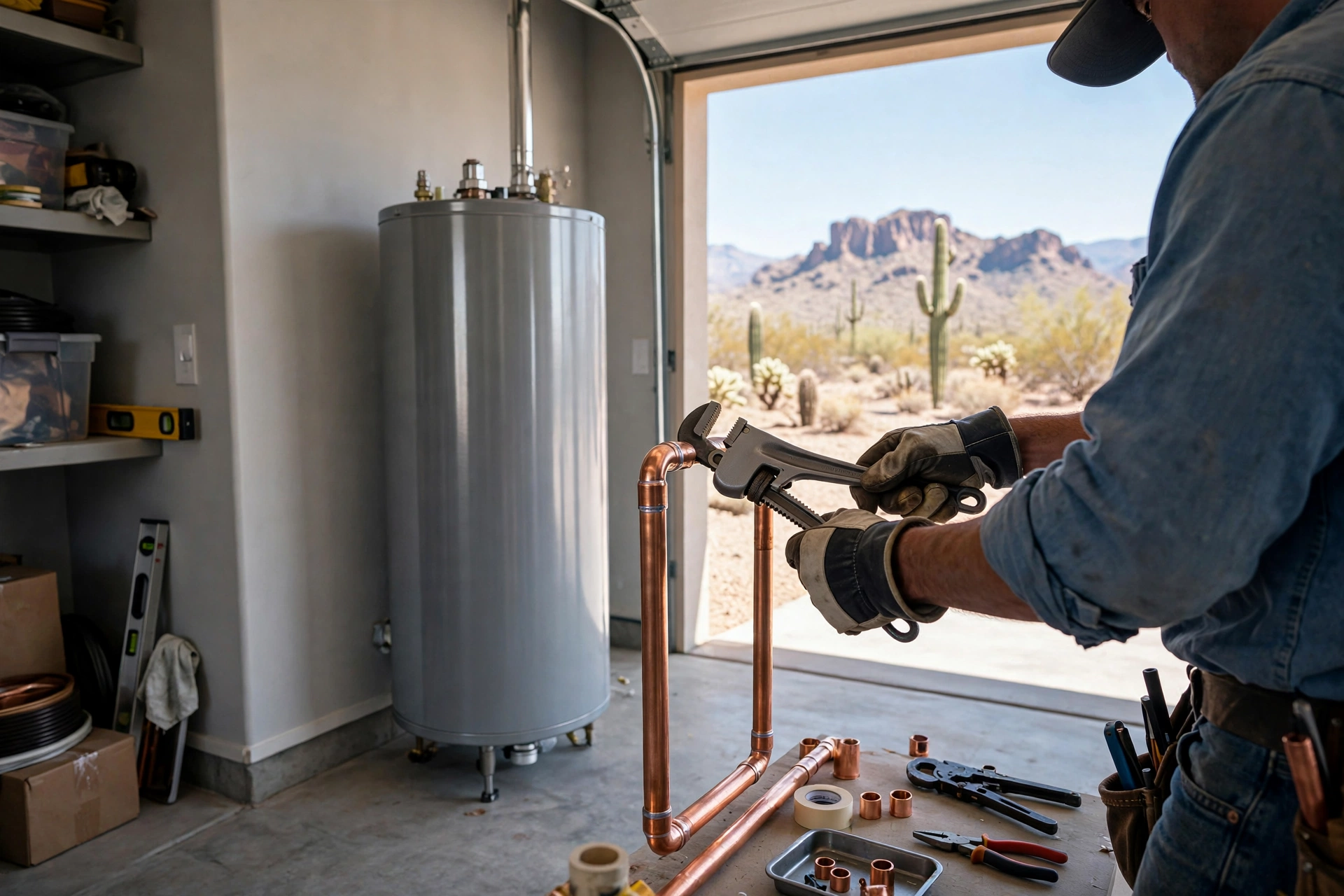
Water heater installation in Bullhead City is a decision you will live with for a decade, and the local conditions should shape it: mineral-heavy groundwater that eats anodes and lays sediment, garages that bake past 110 degrees in summer, seasonal homes that sit unused for months, and households whose demand swings between a quiet couple and a winter houseful of guests. The right unit, correctly sized and properly protected, is the difference between a quiet decade and a rumbling, leaking one.
This page covers how sizing works, tank versus tankless in this climate and water, the installation details that protect the home, and what installation costs in this market — published ranges put a standard install around $762–$1,905.
For pricing context before anything else, the Bullhead City cost page publishes the market ranges water heater installation sits inside — starting with water-heater installation (market range): About $762–$1,905 installed for standard tank units. And if your symptom is broader than water heater installation, the Bullhead City plumbers homepage routes every common symptom to the right service.
What water heater installation covers in Bullhead City
Installation is more than swapping a cylinder. It includes draining and removing the old unit, setting the new tank on a sound pan with a working drain, connecting water, fuel and venting to current code, fitting or checking the expansion tank and T&P discharge line, and commissioning — filling, purging air, setting temperature, and checking for leaks under full pressure and heat. In Bullhead City, two extras deserve attention at install time: a drain pan piped to a safe discharge point, because garage and closet leaks here often run unnoticed, and a hard-water plan — softener pairing or at minimum a flushing and anode schedule — agreed before the first scale forms.
Sizing follows the household's peak hour, not the tank label of the unit being replaced: how many bathrooms, whether a soaking tub or large shower exists, whether the home hosts winter guests, and whether a manufactured home's space and venting constrain the choice. Tankless units suit some Bullhead City homes well — endless hot water and no standby loss during months away — but hard water demands a softener ahead of them and regular descaling, which must be priced into the comparison honestly.
Warning signs you need this service
- Your current heater is leaking from the tank body — replacement, not repair
- The unit is past ten years old in this water and showing corrosion or heavy sediment noise
- Hot water capacity no longer matches the household — guests, additions, a new tub
- Repair quotes are stacking up toward the value of the remaining tank
- Rusty hot water that flushing and an anode change did not cure
- A seasonal home needs a unit that tolerates months of vacancy gracefully
- You are remodelling and the old closet or garage location no longer suits
- Energy bills suggest the old unit is running far longer than it should
What causes it here
Installations are usually triggered by end-of-life failure — and in Bullhead City that timeline is set by water, not by the calendar: sediment insulating the tank floor, anodes consumed early, corrosion at fittings baked by garage heat. Planning the replacement before the tank lets go is the single best way to keep choice — of model, size and timing — in your hands instead of the leak's.
How the work is done
The process: assess demand and location, confirm fuel type and venting, select the unit, and agree the protection package — pan, expansion tank, shut-offs you can actually reach, and a maintenance schedule. On the day, the old unit is drained and removed, connections are renewed rather than reused where they are tired, and the new unit is commissioned and demonstrated: where the shut-offs are, how to read the controls, what the first-year flush involves. Disposal of the old tank is part of the job, not an afterthought left in your garage.
In depth — what experience teaches about this job here
Installation day details compound for a decade, and three of them separate a careful Bullhead City install from a swap. First, the expansion tank: in a hard-water city with long hot runs, thermal expansion is daily stress on every seal in the house, and a correctly charged expansion tank absorbs it. Second, the pan drain: a pan that merely holds water buys hours; a pan piped to a discharge point buys the whole failure. Third, reachable shut-offs: the next decade's emergencies are cheaper when the heater's cold feed and the home's main can be operated by the person standing in the garage, in the dark, the first time.
Owners of seasonal homes should raise vacancy at the sizing conversation, not after. A tank that sits full and hot for five empty months spends energy and anode life protecting nobody; vacation settings, a smaller tank, or tankless each solve that differently, and the right answer depends on how the home is actually used across the year. The installer who asks about your calendar before recommending a model is the installer pricing your life rather than a catalogue page.
How your housing type changes the job
Slab-built homes. In slab homes, the new heater's pan and discharge routing deserve the extra ten minutes: the unit often sits over flooring that a tank failure would ruin.
Manufactured homes. Manufactured installations work within alcove dimensions and factory venting paths; the right unit is the one that fits the home's actual clearances, confirmed before delivery day.
Seasonal homes. Seasonal households should size for their real calendar — the winter houseful, not the summer silence — and choose vacancy-friendly settings at commissioning.
- Count bathrooms and note your peak-use pattern before the sizing conversation
- Photograph the rating plate and the installation space — clearances decide model options
- Decide honestly about vacancy: months-away homes favour certain setups
- Ask for the anode and flush schedule in writing at install time
- Keep the new unit's manual and warranty papers with the home's records
The visit, step by step
Call with the old unit's age, fuel and size, plus your household's peak demand
Sizing and model options are laid out with installed figures, tank and tankless compared honestly
Installation day: removal, new connections, pan and protection fitted, code-checked venting
Commissioning: fill, purge, temperature set, leak check under heat and pressure
Handover: shut-offs, controls and the hard-water maintenance schedule explained
What it costs — market ranges
| Item | Range / basis |
|---|---|
| Water-heater installation (market range) | About $762–$1,905 installed for standard tank units |
| Tankless installation | Higher unit and venting/descale-provision costs; quoted per home |
| Pan, expansion tank and shut-off renewal | Included or itemised in the quote — never a surprise extra |
| Old unit removal and disposal | Part of a complete installation quote |
Ranges above draw on the published Bullhead City market data collected on our cost page. Your figure is set after the job is seen, and explained against those ranges.
A planned installation is a scheduled job. It becomes urgent when the old tank is actively leaking — in that case, shut off the cold supply and fuel, and the replacement can usually be expedited before water damage spreads.
Water Heater Installation FAQs
How much does water heater installation cost in Bullhead City?
Published aggregator ranges for this market put a standard tank installation around $762–$1,905, covering the unit and labour for a like-for-like swap. Tankless units, fuel conversions, venting changes or relocating the unit move the figure up. You will get an installed figure for your specific home before work is agreed — no open-ended labour surprises.
What size water heater does a Bullhead City home need?
Most three-bed, two-bath homes land on a 40- or 50-gallon tank, but the honest answer follows your peak hour: back-to-back showers, a soaking tub, or winter guests push the size up. Seasonal homes with long vacancies sometimes suit a smaller tank or a tankless unit better. Sizing is worked through on the call from your actual fixtures and habits.
Is tankless worth it in Bullhead City's hard water?
It can be — endless hot water and no energy spent keeping a tank hot while the home sits empty all summer. The condition is water treatment: a heat exchanger fed raw Bullhead City groundwater scales quickly, so a softener ahead of the unit and annual descaling are part of the real cost. With those in place, tankless serves many local homes well; without them, a quality tank is the safer spend.
How long does installation take?
A like-for-like tank swap is typically a few hours including draining, removal and commissioning. Conversions — tank to tankless, electric to gas, or a relocation — take longer and may span a day with venting or fuel-line work. You will know the expected window before the day is booked.
What protects my home if the new heater ever leaks?
The installation itself: a sound drain pan piped to a discharge point, a working T&P line, reachable shut-offs, and an expansion tank managing thermal pressure. Add a simple leak alarm in the pan for closet installations. These details cost little at install time and are what separate a contained drip from a flooded garage discovered weeks later in a seasonal home.
Should I fit a water softener with the new heater?
In this water, it is the single best protection for the new tank — softened water slows sediment and anode consumption dramatically and benefits every other fixture too. It is not mandatory, and a flush-and-anode schedule is the alternative. The softener page explains the options, and the conversation is easier before the new tank's first scale forms.
Sizing a heater for the household you actually have
Installation day is the one moment when capacity can be corrected cheaply, yet most replacements simply copy the old tank's label — including the mistakes of whoever chose it. Sizing deserves a short, honest audit. Count the bathrooms, but also count the patterns: a household of two that hosts a dozen river guests on holiday weekends stresses a heater differently from a family of five on a steady routine. Large soaking tubs, multi-head showers and casitas with their own demands each redraw the picture, and Bullhead City's larger homes in areas like Arroyo Vista and Laughlin Ranch regularly run at the edge of a standard tank's recovery. Going larger is not free — standby losses rise with tank size — so the goal is the heater that covers your peak hour without idling expensively through the other twenty-three.
Tank, tankless and the hard-water fine print
Tankless units tempt with endless hot water and a small footprint, and they can be the right choice here — with one local condition stated plainly. Bullhead City's mineral groundwater scales the narrow heat-exchanger passages of a tankless unit faster than it settles in a tank, so a tankless installation without a descaling routine or upstream treatment is a machine on a countdown. Budget for periodic descaling as part of ownership, or pair the unit with softening, and the technology performs as promised. A conventional tank is more forgiving of neglect but pays for it in sediment and efficiency loss over the years. Neither technology is the automatic winner; the honest comparison for your home weighs usage pattern, water treatment and maintenance appetite together.
Installation details that decide the next decade
The difference between a heater swap and a heater installation lives in the details around the tank. A new drain pan piped to a real discharge point turns a future tank failure from a flood into an inconvenience. Fresh shut-off valves that actually close, an expansion tank sized to the system, and seismic strapping where required are each inexpensive on the day and expensive to retrofit. The temperature setting matters too: hot enough to serve the home and discourage bacterial growth in stored water, not so hot that scale forms faster and scald risk climbs. Ask for each of these to be itemised in the quote — included or priced — so the installation you approve is the installation that happens.
- Photograph your current heater's label before calling; model, capacity and fuel type speed up an accurate quote.
- Decide in advance where the old unit goes — a complete quote includes removal and disposal, not a tank left in your garage.
- If the heater sits in a closet or attic, budget for the pan, discharge line and a leak alarm as part of this installation.
- Tell us about planned additions — a casita, a remodelled bathroom, a larger household — so sizing anticipates them.
- Schedule the first flush and anode check into your calendar before the installer leaves; protection starts in year one.
The market frame for standard tank installations here runs roughly $762–$1,905 installed, with the full table on the Bullhead City cost page. A call to (928) 693-1910 with your household's real pattern — residents, guests, bathrooms, treatment — turns that frame into a sized, itemised figure rather than a label copied off the old tank.
Related services and areas
Homeowners dealing with this often also need emergency plumber · drain cleaning · hydro jetting · leak detection · slab leak repair — and local help from a plumber in Bullhead City who knows the housing on your street. Neighbourhood pages: Riviera · Riverview Park · Laughlin Ranch · Fox Creek · Sunridge Estates · Buena Vista · Holiday Shores · Holiday Highlands · Desert Foothills Estates · Arroyo Vista · Bullhead City Center · Playa del Rio · Rio Lomas · Hancock Road Corridor. Town pages cover Fort Mohave, Mohave Valley and Laughlin, NV.
Water Heater Installation by neighbourhood
Neighbourhood-level pages pair this service with each area's housing and conditions: Water Heater Installation in Riviera · Water Heater Installation in Riverview Park · Water Heater Installation in Laughlin Ranch · Water Heater Installation in Fox Creek · Water Heater Installation in Sunridge Estates · Water Heater Installation in Buena Vista · Water Heater Installation in Holiday Shores · Water Heater Installation in Holiday Highlands · Water Heater Installation in Desert Foothills Estates · Water Heater Installation in Arroyo Vista · Water Heater Installation in Bullhead City Center · Water Heater Installation in Playa del Rio · Water Heater Installation in Rio Lomas · Water Heater Installation in Hancock Road Corridor.
Talk to a Bullhead City plumber today
One call, a real conversation about your job, and an honest next step.
(928) 693-1910Call (928) 693-1910