 Plumber
 Bullhead City, AZ
Toilet Repair in Bullhead City, AZ
Running, rocking, leaking and weak-flushing toilets fixed properly — including the wax seal and flange problems that quietly rot floors.
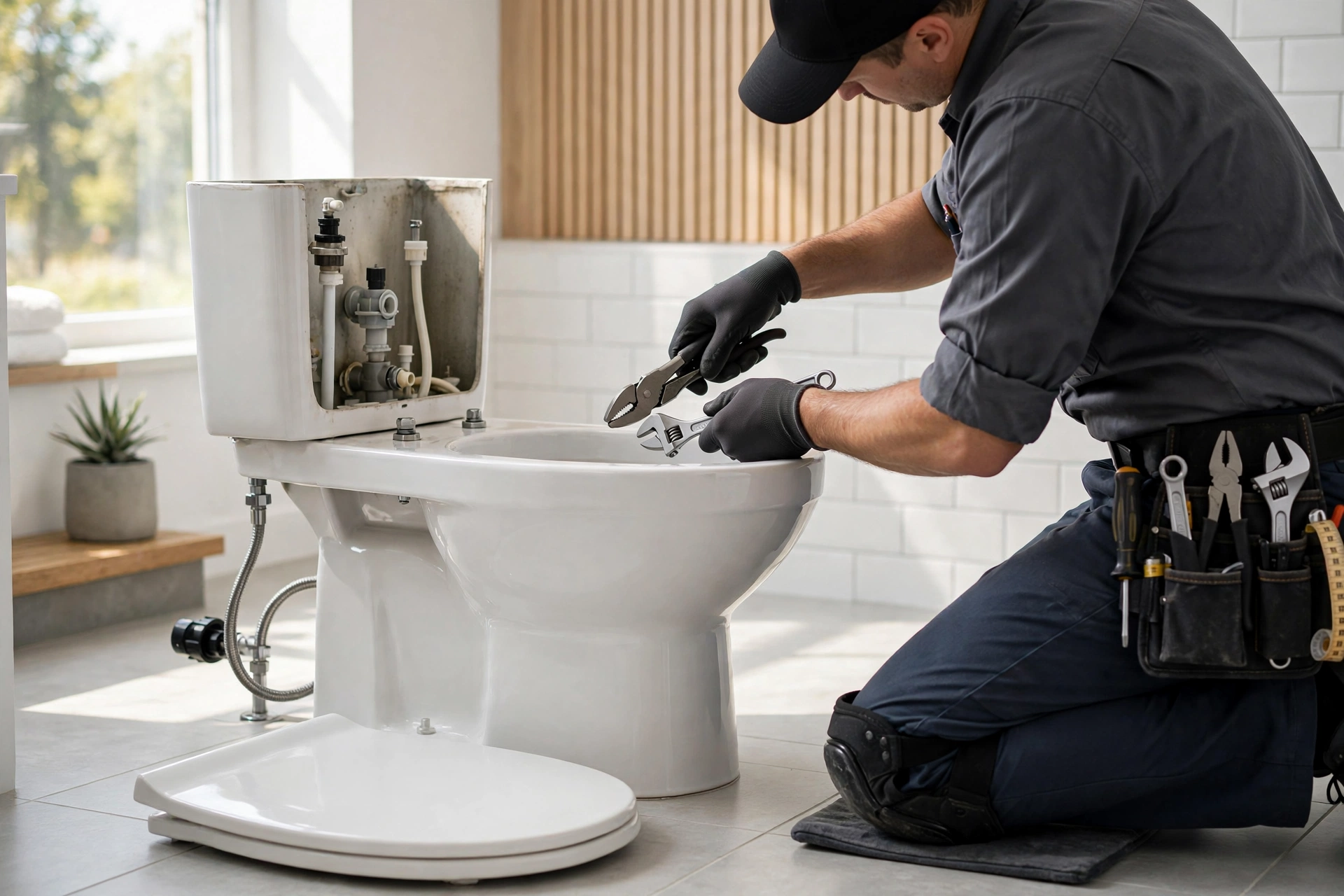
Toilet repair sounds minor until you price a toilet that runs all day in the desert: hundreds of gallons a week of treated groundwater, billed monthly, from a flapper that costs very little. Or until a rocking toilet's failed wax seal has been leaking into the floor structure for a season — the Bullhead City pattern in which a small job becomes a flooring job.
This page covers the faults that matter: constant running, weak or double flushing, leaks at the base, rocking, fill problems and hard-water-specific wear, plus the honest line between a rebuild, a seal replacement and a new toilet.
For pricing context before anything else, the Bullhead City cost page publishes the market ranges toilet repair sits inside — starting with typical minor plumbing job (market frame): About $125–$450 average job range in this market. And if your symptom is broader than toilet repair, the Bullhead City plumbers homepage routes every common symptom to the right service.
What toilet repair covers in Bullhead City
A toilet is a tank of mechanisms sitting on a wax seal over a floor flange. The tank side — fill valve, flapper or tower seal, flush handle, overflow tube — decides running and flushing faults. The base side — wax ring, flange height, closet bolts — decides leaks and rocking. Hard water attacks both: scale stiffens flappers and crusts rim jets so the flush weakens, while fill valves clog with grit and sediment from the well-water supply.
In Bullhead City's manufactured homes, floor structure adds a third consideration: a toilet that rocks on a weakened particleboard or plywood floor needs the floor assessed, not just a thicker wax ring. In seasonal homes, toilets sit unused for months — seals dry, flappers warp in the heat, and the first flush of the season is when the failures announce themselves.
Warning signs you need this service
- A toilet that refills briefly every few minutes with no use
- Water visibly trickling into the bowl between flushes
- A weak flush, a double-flush habit, or a handle that must be held down
- Water at the base, a spongy floor, or a sewer smell at floor level
- Rocking or movement when you sit or shift weight
- A hissing fill that never quite stops, or a very slow refill
- Rusty or gritty deposits in the tank and crusted rim jets
- Ghost flushing in a seasonal home that sat empty — a leak announcing itself
What causes it here
Flappers and seals perish in chlorinated, mineral water and desert heat; fill valves jam with grit; scale narrows rim jets until the flush loses its siphon. At the base, wax rings compress and fail with age or when a toilet is lifted and reset on the old ring, and flanges corrode or sit at the wrong height after flooring changes — a common find after a remodel in Sunridge Estates or Desert Foothills homes where new tile raised the floor around an untouched flange.
How the work is done
Diagnosis starts with dye and observation: food colouring in the tank reveals a flapper leak into the bowl without a flush. Tank mechanisms are rebuilt with quality parts matched to the toilet — universal kits fit poorly on many models. Base leaks mean lifting the toilet, inspecting the flange and the floor, and resetting on a new seal at the correct height; if the floor structure is soft, that repair is quoted honestly rather than sealed over. Finally the rebuilt toilet is flush-tested repeatedly, because intermittent faults hide from a single test.
In depth — what experience teaches about this job here
The running toilet deserves its reputation as the most underestimated bill in the house. It is silent in a closed bathroom, invisible on the fixture, and steady around the clock — a leak with no puddle, metered by the city and paid monthly. In a groundwater city, the waste argument doubles: every gallon a flapper passes was pumped, treated and pressurised to reach a bowl it did not need to fill. Dye-testing every toilet in the house takes twenty minutes and is the highest-value DIY diagnostic on this entire site; households that do it annually simply do not pay the running-toilet tax.
Base leaks carry the opposite profile: small water, large consequence. The wax seal's failure admits a little water at every flush into the one place it cannot dry — against the subfloor, around the flange, under the flooring. By the time the floor feels soft, the repair has grown a carpentry chapter. The discipline is to treat the earliest signs — a faint ring stain, a slight rock, a smell at floor level on a still day — as the repair window, because at that stage the job is still a seal, an hour and a dry floor preserved.
How your housing type changes the job
Slab-built homes. On a slab, a base leak has nowhere to go but into flooring edges and wall bases, which makes early resealing even more valuable than in raised-floor homes.
Manufactured homes. Manufactured-home toilet repairs always include the floor check: the unit's seal and the structure under it are one job in this housing, never two separate guesses.
Seasonal homes. Toilets are the seasonal home's first failure and its cheapest check: dye-test every one on arrival week, before the flapper tax starts compounding.
- Do the dye test: colour the tank water, wait twenty minutes, and check whether colour appears in the bowl
- Check the water level against the tank's marked line — overfilling spills silently into the overflow
- Feel the floor around the base for softness and look for staining — early seal leaks show there first
- Turn the angle-stop valve off and on once; a valve that has not moved in years may not close when you need it
- In a seasonal home, flush every toilet on arrival and check bases the next morning for dampness
The visit, step by step
Call describing the symptom — running, leaking, rocking or weak flush
Tank mechanisms are dye-tested and inspected; the base and floor are checked
Rebuild, reseal or replacement options are priced plainly
Work is completed and the toilet is flush-tested through several cycles
You are shown the shut-off and what was changed, so the next symptom is readable
What it costs — market ranges
| Item | Range / basis |
|---|---|
| Typical minor plumbing job (market frame) | About $125–$450 average job range in this market |
| Tank rebuild (valve, flapper, seals) | Priced by model and parts; the most common repair |
| Lift, reseal and flange correction | Priced by flange and floor condition found on lifting |
| Toilet replacement | Quoted including the new unit's class, haul-away and reset |
Ranges above draw on the published Bullhead City market data collected on our cost page. Your figure is set after the job is seen, and explained against those ranges.
A toilet leaking at the base or a tank crack that is actively spilling is urgent — shut its angle-stop valve. A running toilet is a wallet emergency rather than a property one: book it promptly, because the water waste in Bullhead City's billed groundwater adds up every single day it runs.
Toilet Repair FAQs
Why does my toilet run every few minutes in Bullhead City?
Almost always a sealing fault: a scale-stiffened or warped flapper letting tank water seep into the bowl until the fill valve tops up the level. The dye test proves it in twenty minutes. In this water, flappers perish faster than in soft-water cities, so a recurring run every year or two points to water quality — and sometimes to high pressure — rather than bad parts.
How much water does a running toilet waste?
A moderate flapper leak can pass several hundred gallons a day; even a slow seep commonly wastes thousands of gallons a month. In a desert city supplied by groundwater wells, that is both a bill problem and a resource problem. It is the rare repair that demonstrably pays for itself in avoided water charges.
Water at the base of my toilet — is it always the wax ring?
Not always: tank-to-bowl bolts, the supply connection, or condensation in a humid bathroom can mimic a base leak. But water at the base combined with rocking or a sewer smell is the wax seal until proven otherwise, and that proof requires lifting the toilet. Do not caulk around the base to hide it — that traps the leak against the floor.
Should I repair or replace my toilet?
Repair when the porcelain is sound and the fault is in the tank mechanisms or the seal — most toilets qualify. Replace when the bowl is cracked, the rim jets are scaled beyond cleaning, the model is a chronic poor flusher, or a remodel changes the rough-in or height needs. A modern replacement also uses markedly less water per flush, which matters on Bullhead City bills.
Why does my toilet rock, and can it be fixed?
Rocking comes from an uneven floor, a failed seal letting the base move, or a flange sitting too low or too high. The fix is to lift, inspect and reset correctly — shims, the right seal stack, and flange correction if needed. Rocking ignored becomes a leak: the movement pumps the seal until it fails, so treat motion as an early warning, not a quirk.
We leave for summer. What should I do about the toilets?
Flush, then consider turning the water off to the house for long absences; at minimum, have someone run water monthly if the supply stays on. On return, expect seals to have dried and check each toilet's base and fill over the first day. Many seasonal owners book a return-home check that covers toilets, the heater and a meter test in one visit.
The running toilet: Bullhead City's most expensive small sound
A toilet that refills itself every few minutes sounds harmless, which is exactly why it out-earns almost every other small plumbing fault in this city. The water is billed groundwater, the leak runs around the clock, and in a seasonal home it can run unattended for an entire summer — a flapper's slow seep multiplied by ninety empty days. The arithmetic surprises people: a modest tank leak can waste more water in a month than the household deliberately uses. That is why the humble toilet deserves its own page and its own urgency. Most of its faults — a perished flapper, a fill valve that never quite closes, a cracked overflow tube — are inexpensive parts. The expensive version of this repair is the one postponed for a season.
Rocking, staining and the leak you cannot see
Not every toilet fault announces itself in sound. A toilet that rocks slightly on its base is breaking its wax seal a fraction at a time, and each flush can push a small amount of water where it should never go — under flooring that then softens, stains or smells musty long before anyone suspects the fixture above it. Rust-coloured staining at the base, a spongy patch of floor beside the bowl, or a musty odour in a bathroom that is otherwise clean are the surface chapters of that story. Lifting the toilet, inspecting the flange and resealing properly is the whole repair; caulking around the base to hide the symptom is the one response that reliably makes the eventual bill larger.
Repair the mechanism or replace the fixture?
The honest answer depends on where the failure lives. Faults inside the tank — valves, flappers, handles, seals — almost always justify repair, because the porcelain around them outlasts several generations of mechanism. Cracks in the bowl or tank, chronic staining etched into old porcelain, or a very old high-volume fixture change the calculation: replacement brings a modern, lower-volume flush that suits a billed-groundwater city, and it resets the seal and flange questions at the same time. What should not drive the decision is fashion alone, and what should never happen is a new mechanism installed into a cracked tank because the crack was not mentioned.
- Drop food colouring in the tank and check the bowl in twenty minutes; colour appearing means the flapper is passing water.
- Listen once a month at each toilet in a quiet house — the phantom refill is easiest to hear when nothing else runs.
- Grip the bowl gently and test for rocking; any movement at the base earns a reseal before the floor pays for the delay.
- In a seasonal home, check every toilet on arrival and again a day later; seals dried out over summer often fail in the first week back.
- Keep the angle-stop valve at each toilet exercised and reachable — it is your first response to any tank or supply failure.
Minor work sits inside the typical $125–$450 average job range published for this market, with the breakdown on the Bullhead City cost page. Call (928) 693-1910 with what you are hearing or seeing — running, rocking, staining — and the visit arrives with the right parts and the right plan for that specific fault.
The guest-bathroom effect
Toilets that serve guests live the hardest diagnostic life in a river town: they sit unused for weeks — long enough for flappers to warp, tank seals to dry and supply connections to develop the slow weep nobody notices — and are then asked to perform flawlessly through the busiest weekends of the year. The failures that embarrass a host on a Saturday night were usually visible a month earlier to anyone who lifted the tank lid. Give guest bathrooms the same colouring-test and base check as the master bath before the season's first visitors arrive, run their taps and showers to refill every trap, and the spare toilet stops being the household's most likely surprise.
Related services and areas
Homeowners dealing with this often also need emergency plumber · drain cleaning · hydro jetting · leak detection · slab leak repair — and local help from a plumber in Bullhead City who knows the housing on your street. Neighbourhood pages: Riviera · Riverview Park · Laughlin Ranch · Fox Creek · Sunridge Estates · Buena Vista · Holiday Shores · Holiday Highlands · Desert Foothills Estates · Arroyo Vista · Bullhead City Center · Playa del Rio · Rio Lomas · Hancock Road Corridor. Town pages cover Fort Mohave, Mohave Valley and Laughlin, NV.
Talk to a Bullhead City plumber today
One call, a real conversation about your job, and an honest next step.
(928) 693-1910Call (928) 693-1910