 Plumber
 Bullhead City, AZ
Mobile Home Plumbing in Bullhead City, AZ
Belly-space lines, poly piping, tub and fixture work for Bullhead City's manufactured homes — done by people who know the construction.
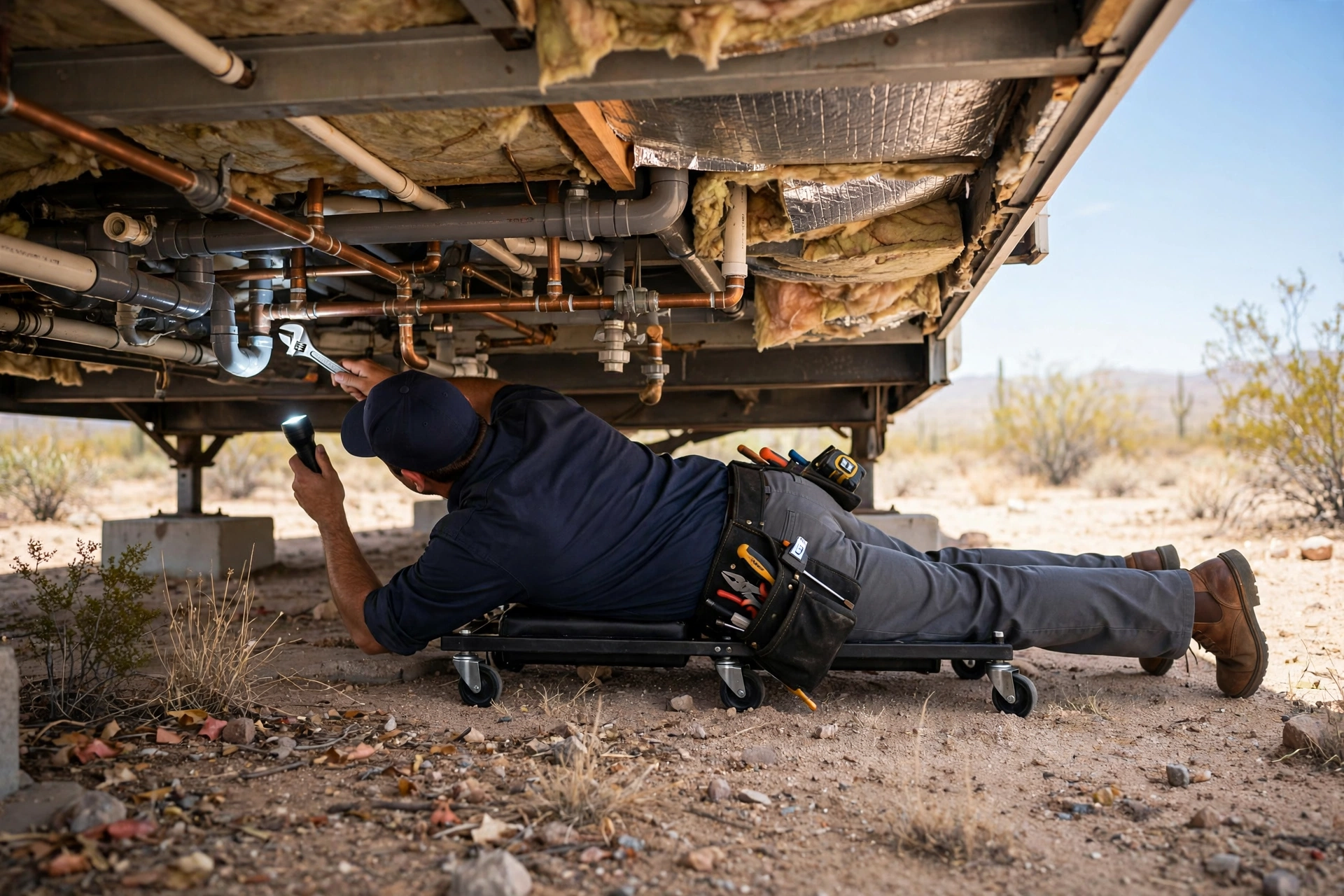
Mobile home plumbing in Bullhead City is not a sideline — manufactured homes are a defining share of this city's housing, from the 55+ communities at Fox Creek to the land-owned lots of Buena Vista, the mixed streets of Holiday Highlands and the older placements in Riviera. Their plumbing differs from site-built homes in access, materials and failure patterns, and it deserves its own page and its own expertise.
Supply and drain lines run through the insulated belly beneath the floor. Original poly piping ages under desert heat cycles. Fixtures are often sized and fitted differently. This page covers the work manufactured-home owners actually call about — and how to tell a belly-line problem from an in-home one.
For pricing context before anything else, the Bullhead City cost page publishes the market ranges mobile home plumbing sits inside — starting with typical job frame in this market: Average job range about $125–$450 for standard repairs. And if your symptom is broader than mobile home plumbing, the Bullhead City plumbers homepage routes every common symptom to the right service.
What mobile home plumbing covers in Bullhead City
A manufactured home's plumbing lives in two zones: the visible fixtures inside, and the belly space below, where water lines, drain runs and the tub and toilet connections are wrapped in insulation and enclosed by belly board or underbelly material. Access means opening that enclosure carefully and refitting it properly — insulation and belly integrity are part of the plumbing job, because the enclosure protects the lines from heat, cold and animals.
The classic Bullhead City manufactured-home jobs: ageing poly supply lines that split or weep at fittings, belly insulation soaked by a slow leak until the floor softens above it, tub and shower units with access challenges unknown in site-built homes, shut-offs that were never fitted per fixture, and freeze or heat damage in skirting vents. Seasonal occupancy sharpens everything — a belly leak in an empty home can run for a month before the neighbour notices the meter.
Warning signs you need this service
- A soft, spongy or sagging floor area, especially near bathrooms
- A musty smell with no visible leak inside the home
- Belly material bulging or hanging low between the frame rails
- Low pressure in one half of the home but not the other
- A water bill for an empty home, or a meter that moves with taps off
- Repeated leaks at poly fittings — grey or black plastic lines with metal bands
- A tub or shower that flexes, creaks or has cracked around the drain
- Skirting damage, animal entry, or visible dripping under the home
What causes it here
Heat is the primary ageing force: belly spaces bake through Bullhead City summers, and poly piping and its fittings embrittle across thousands of heat cycles. Ground settling shifts the home on its piers and stresses rigid connections. Original construction used materials and fittings chosen for factory speed, not fifty-year service, and many homes are now well past those lines' intended life. Rodents and pets entering damaged skirting occasionally add chewed lines to the list.
How the work is done
Work starts by identifying the system: poly, PEX, copper or a mixture from decades of repairs, because joining methods differ and some original materials should be replaced rather than extended. Belly access is opened at the right bay, the repair or repipe is completed with properly supported and insulated lines, and the enclosure is refitted so the protection is restored. Fixture work inside — tubs, showers, toilets — accounts for the floor structure beneath, reinforcing rather than loading a weakened floor. Whole-home repipes of manufactured homes are common here and are covered in depth on our repiping page.
In depth — what experience teaches about this job here
The belly is a system, not a hiding place. Its insulation keeps lines from baking and freezing, its board keeps animals and weather out, and its integrity is why manufactured-home plumbing can serve for decades in a desert that destroys unprotected pipe. Every opening of that system is therefore two jobs: the pipe work, and the restoration of the enclosure to its original protective state. Quotes that price only the pipe are pricing half the job, and the missing half is the part that decides how long the repair — and the lines around it — actually last.
Floor feel is the manufactured-home owner's best instrument. A belly leak announces itself upward long before it drips visibly below: a patch of floor that gives slightly, a hollow note where the step used to land solid, a musty breath when the bathroom door opens on a still morning. Owners who learn their floors' normal feel catch leaks in the inexpensive week. The check costs nothing, takes a barefoot minute, and in Buena Vista and Holiday Highlands housing it is worth more than any sensor you can buy.
How your housing type changes the job
Slab-built homes. Owners moving between the two housing types should know the trades differ: the slab home's hidden lines are under concrete; the manufactured home's are in the belly — different access, different evidence, different craft.
Manufactured homes. This is the home turf of this page: Buena Vista, Holiday Highlands, Fox Creek and the Center's 55+ communities are where belly systems, poly lines and floor condition are assessed as one system.
Seasonal homes. Manufactured seasonal homes combine both risk patterns — belly lines and vacancy — which is why their return routine includes the skirting walk as a named step.
- Walk the skirting monthly: bulges, drips and animal damage show there first
- Know your home's main shut-off location — many manufactured homes lack per-fixture stops
- Check after any floor softness appears; belly leaks announce themselves through the floor
- Photograph the underbelly before and after any work — access quality varies and records help
- For seasonal absences, shut the water off at the home's main and drain exposed lines
The visit, step by step
Call with the symptom and your home's age and type if you know them
The system is identified — materials, routing, previous repairs — before quoting
Belly access is opened at the correct bay and the fault located
Repair or repipe is completed with supported, insulated lines
The belly enclosure is refitted, floors checked, and the system pressure-tested
What it costs — market ranges
| Item | Range / basis |
|---|---|
| Typical job frame in this market | Average job range about $125–$450 for standard repairs |
| Belly-line repair | Priced by access and the length of damaged run |
| Manufactured-home repipe | Quoted by home size; see the repiping page for the staging approach |
| Tub/shower replacement | Quoted including floor-structure assessment beneath the unit |
Ranges above draw on the published Bullhead City market data collected on our cost page. Your figure is set after the job is seen, and explained against those ranges.
A burst belly line or a leak soaking the floor structure is urgent — shut the home's main water off and call the same day. Slow symptoms — a softening floor patch, a musty smell — are prompt scheduled work that should not wait a season, because belly damage compounds invisibly.
Mobile Home Plumbing FAQs
Why do manufactured homes in Bullhead City have so many plumbing problems?
A combination of materials and environment: original poly piping that embrittles, belly spaces that bake through desert summers, and homes that shift slightly on their piers over decades, stressing connections. None of it means the home is failing — it means its plumbing is at the age where planned renewal, especially repiping tired poly, beats a drip-by-drip approach.
What is the belly of a manufactured home and why does it matter?
It is the enclosed, insulated space beneath the floor containing the water and drain lines. Its insulation and belly board protect pipes from heat, cold and animals. When a leak soaks that insulation, floors soften and lines lose protection — which is why proper repairs include refitting the enclosure, not just fixing the pipe and leaving the belly open.
Can my manufactured home be repiped?
Yes — it is one of the most common and most valuable jobs on this housing stock. Old poly is replaced with properly supported, insulated PEX runs, usually in days, staged so the household keeps water where possible. The repiping page explains the staging, and manufactured-home quotes account for belly access and enclosure refitting.
My floor is soft near the tub. Is that plumbing or structure?
Usually plumbing first: a slow tub drain or supply leak soaking the subfloor from below or behind is the classic cause in manufactured homes. The assessment checks both — fix the leak source, then judge how much floor structure needs renewal before a new unit or seal loads it again. Sealing over a soft floor without finding the leak guarantees a repeat.
Are manufactured-home fixtures different from regular ones?
Often, yes: tubs and showers may be sized for the home's framing, drain positions differ, and some original fittings are specific to manufactured housing. An experienced mobile-home plumber carries or sources the right parts instead of forcing site-built fittings — one reason this work is its own specialism rather than a generic call-out.
We leave our manufactured home empty all summer. How do we protect it?
Shut off the water at the home's main valve, drain what you can, and have a neighbour or service check the meter monthly if possible. On return, repressurise slowly, walk the skirting, check every fixture and the floors near bathrooms, and flush standing water as the city advises. A return-home plumbing check catches the season's surprises early.
Under the home: a guided tour of the belly
Manufactured-home plumbing lives in a world most site-built homeowners never see: the belly, the enclosed underside where supply and drain lines run between the floor and the belly board that seals them from below. Understanding that space explains nearly every mobile-home plumbing behaviour in Bullhead City. Lines there are supported in long spans that can sag as hangers age, creating low spots where water and sediment settle. The belly board and insulation that protect those lines from desert temperature swings also hide them — a slow drip can soak insulation for months, announcing itself only as a bulge in the belly, a musty smell at a floor vent, or a patch of floor turning soft above a saturated section. Every diagnosis under a manufactured home therefore starts with reading those indirect signs before anyone opens a single panel.
Heat, cold and the desert swing underneath
It surprises newcomers that pipes freeze in the desert, yet Bullhead City's winter nights can drop below freezing while the belly's insulation is thinnest exactly where repairs once opened it. Heat tape on vulnerable runs, intact belly board and properly re-fitted insulation after any repair are not finishing touches here — they are the difference between a repair that lasts and the same line splitting at the next cold snap. Summer writes the opposite chapter: heat under a sun-baked home ages plastic fittings and dries out seals, and vacant seasonal units bake hardest of all. A manufactured home that sits closed through the furnace months deserves a slow, watched repressurisation on its owner's return, with the belly checked before the household settles back into full water use.
Anchors, additions and the plumbing nobody permitted
Manufactured homes accumulate history: a porch enclosed, a laundry moved, an Arizona room added by a previous owner with enthusiasm exceeding documentation. Those additions often carry plumbing of uncertain route and material, tied into the original system at points nobody recorded. When a problem surfaces in an added section, expect the diagnosis to spend as much effort on archaeology as on repair — tracing which line feeds what, and which era of material each section belongs to. This is also why honest records matter so much in these homes: a simple note of what was found and changed, kept with the home's papers, can save the next repair — and the next owner — hours of expensive rediscovery beneath the floor.
- Walk the skirting monthly; gaps invite pests and weather into the belly where your pipes live unprotected.
- Treat any soft floor patch near a bathroom or the water heater as a plumbing symptom until it is proven structural.
- After any under-home repair, confirm insulation and belly board were restored — ask to see the closed belly, not just the fixed pipe.
- Before winter, check that heat tape on exposed runs is present, powered and not buried under new insulation incorrectly.
- Keep a dated note of every under-home finding with the home's documents; in manufactured homes, memory is not a filing system.
Standard repairs sit inside the typical $125–$450 average job range published for this market, with the full frame on the Bullhead City cost page. Call (928) 693-1910 describing your home's type, its era and what you are seeing or smelling — in manufactured homes those details are half the diagnosis before anyone crawls underneath.
Buying or selling a manufactured home: the plumbing questions
Manufactured homes change hands often in Bullhead City, and their plumbing deserves specific questions in any transaction. Ask which pipe materials the home carries and whether any section has already been repiped, because a home half-converted tells a very different story from an original one. Ask about past belly openings and whether insulation was restored, about freeze history in cold winters, and about any floor repairs near bathrooms — each is a clue to water events the walls cannot show. A pre-purchase plumbing look beneath the home, reading the belly for bulges, stains and patchwork, is inexpensive diligence for the one part of the property a standard walk-through never sees, and it frequently decides whether the plumbing is an asset or a negotiation.
Related services and areas
Homeowners dealing with this often also need emergency plumber · drain cleaning · hydro jetting · leak detection · slab leak repair — and local help from a plumber in Bullhead City who knows the housing on your street. Neighbourhood pages: Riviera · Riverview Park · Laughlin Ranch · Fox Creek · Sunridge Estates · Buena Vista · Holiday Shores · Holiday Highlands · Desert Foothills Estates · Arroyo Vista · Bullhead City Center · Playa del Rio · Rio Lomas · Hancock Road Corridor. Town pages cover Fort Mohave, Mohave Valley and Laughlin, NV.
Talk to a Bullhead City plumber today
One call, a real conversation about your job, and an honest next step.
(928) 693-1910Call (928) 693-1910